
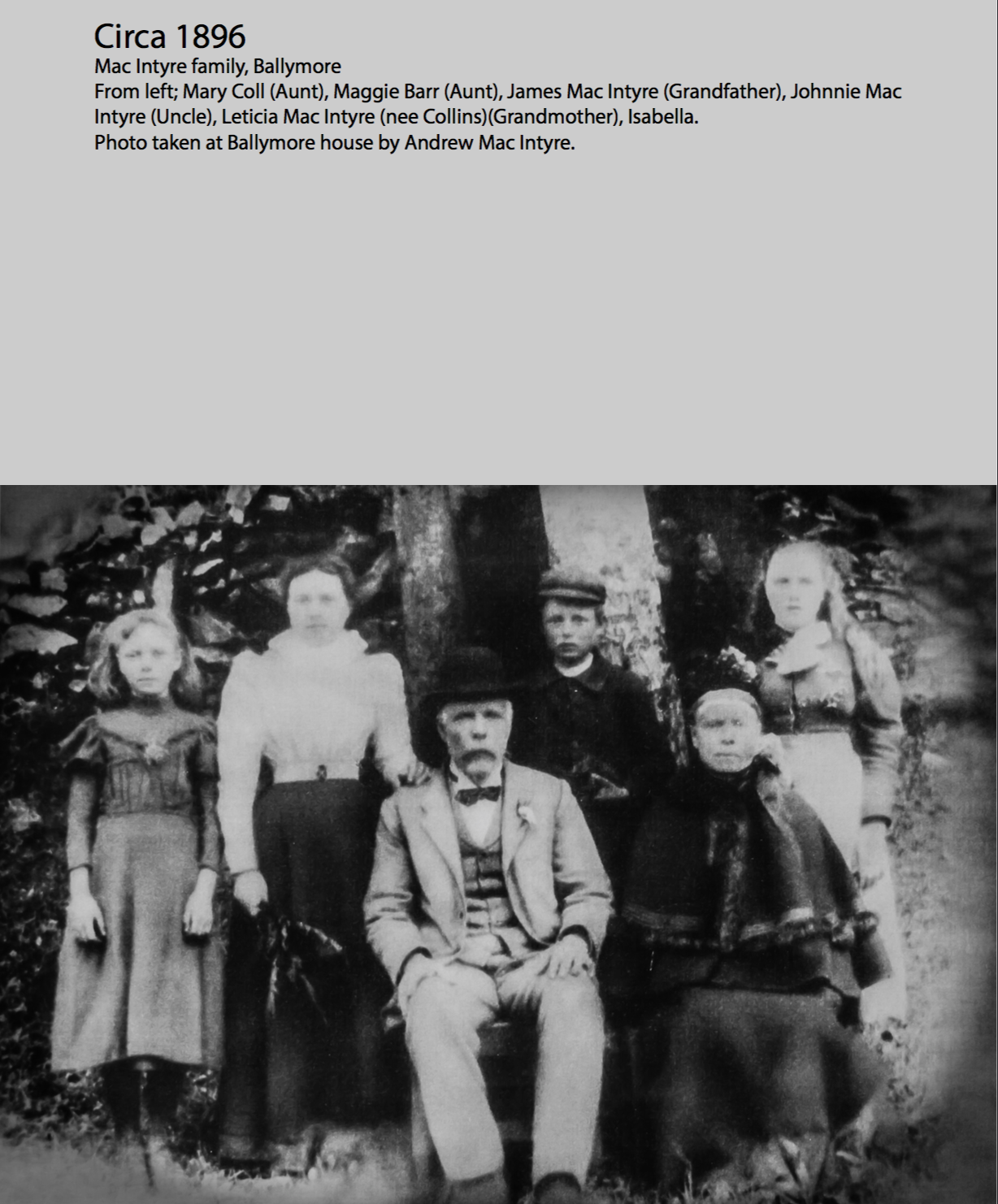
 There were six of us, myself (the eldest), Maggie, (Mrs William Barr); James, Isabella (Mrs Patrick O’Donnell); Johnnie and Mary (Mrs Edward Coll). I am not writing my autobiography but I feel that I must give some outline of my life, even up to the present time. (1956)
I was sent to Ballymore National School, early in the eighties, the principal teacher was Mary Elizabeth Parker, with her two sisters as assistants, Louisa and Esther Anna. I cannot speak too highly of Miss Parker, Ballymore. The school was nominally a Protestant school, though; when I was there the majority of pupils were Catholic. This was before the erection of the Kildarragh School. I must say that Miss Parker, during all my time under her, never showed the least trace of bigotry. She was meticulously fair to all her pupils in all respects. To her, they were neither Protestant nor Catholic. They were her pupils whom she had been appointed to educate. She had the art of inspiring those under her charge with a love of learning and a desire for more knowledge. I feel I owe a deep debt to her which I can never repay.
After I left school I was appointed postman in the district, with the rank of rural auxiliary, and at a wage of 5/- per week. I did not yet know to whom, or to what, I was auxiliary-helper-as there was no one except myself. My walk each day was Ballymore, Cloonmass, Lower Faugher, Marblehill, Knockduff, Parkmore, Dundridian, Breaghy, Port-na-Blagh, Rockhill, Middle and Upper Faugher and later Knocknafaugher. When the last town land was added I received an increase of 6d per week. I continued for 11 years and 9 months, and gave it up in the middle of December 1909, when I had reached the sum of 8/6d per week. During these years I had a good deal of time to myself in the evenings, and I employed it in reading widely, and in studying Irish, French and shorthand. Mr Hugh A. Law, Marblehill, placed his extensive library at my disposal. I had accumulated some books of my own, especially poetry and drama. I had Dick’s Shilling Shakespeare, Moore, Byron, Tennyson, Robert Browning, Cowper, Longfellow and some anthologies. I had read Irish history – D’Arcy McDee, Sullivan, Cardinal Moran’s “Persecutions of the Irish Catholics under the Penal Laws”, and other works. From 1910 to 1914, I worked on the farm at home. Then in the month of September 1914, I was appointed Master of Dunfanaghy Workhouse. I held the position from October 1st.1914 to 31st.March 1917, when the Institution was closed and the inmates sent to Milford. I could write a book on my experiences in Dunfanaghy during these two and a half years but I cannot do it here. It was when I was Workhouse Master that, on 31st.October 1916, I married Mary Martin of Derryreel.
When the House was closed on 31st.March 1917, I found myself with my work terminated, and with no compensation for loss of office. The Matron, Nurses, Wardsmaids, had received pensions or compensations, but I had not held a permanent position for the reason that the Guardians had appointed me only from year to year. I did not know that until it was too late, and this mistake has deprived me of a pension of some sort from that day to this.
In 1918, the position of School Attendance Officer for Clondahorkey parish became vacant by the resignation of Niall McBride. I applied and was appointed. I had to visit every month, the following schools: Murroe, Dunfanaghy No.1 and No.2, Ballymore, Kildaragh, Massinass Male and Female, Creeslough, Milmacloo and Drumnaraw. The salary was £12 per annum which was later increased to £18. It was hard earned money and had no relation the amount of work, travelling, visiting defaulting parents, sending out notices etc… However, my circumstances at the time compelled me to the position until something better came my way.
That something came in 1921, at the end of that year, when the Carnegie Irish Advisory Committee in Dublin offered me the Assistantship in the new Carnegie Library (the first County Library in Ireland) to be started in Lifford. I accepted and came to Lifford in January 1922. The salary was £2 per week, not a princely sum, but far in advance of anything I had hitherto been getting, and with the possibilities of further advancement. For a year and a quarter I was assistant, then in March 1923, my supervisor, Mr Sam Maguire, County Librarian, went to Coleraine, Co.Derry to organise a library there and I was put in charge with an increase in salary to £150 per annum. Mr Maguire afterwards went to Sligo for the same purpose, and I still carried on. Towards the end of 1923 when the library was to be taken over by the County Council, I received word from the Carnegie Trust, Dunfermline that a Library examination was to be held in Dublin and that, unless I passed, they could not recommend me to the Council for appointment as County Librarian.
Written by Andrew MacIntyre II
 lovemacintyre.com
You must be logged in to post a comment.