
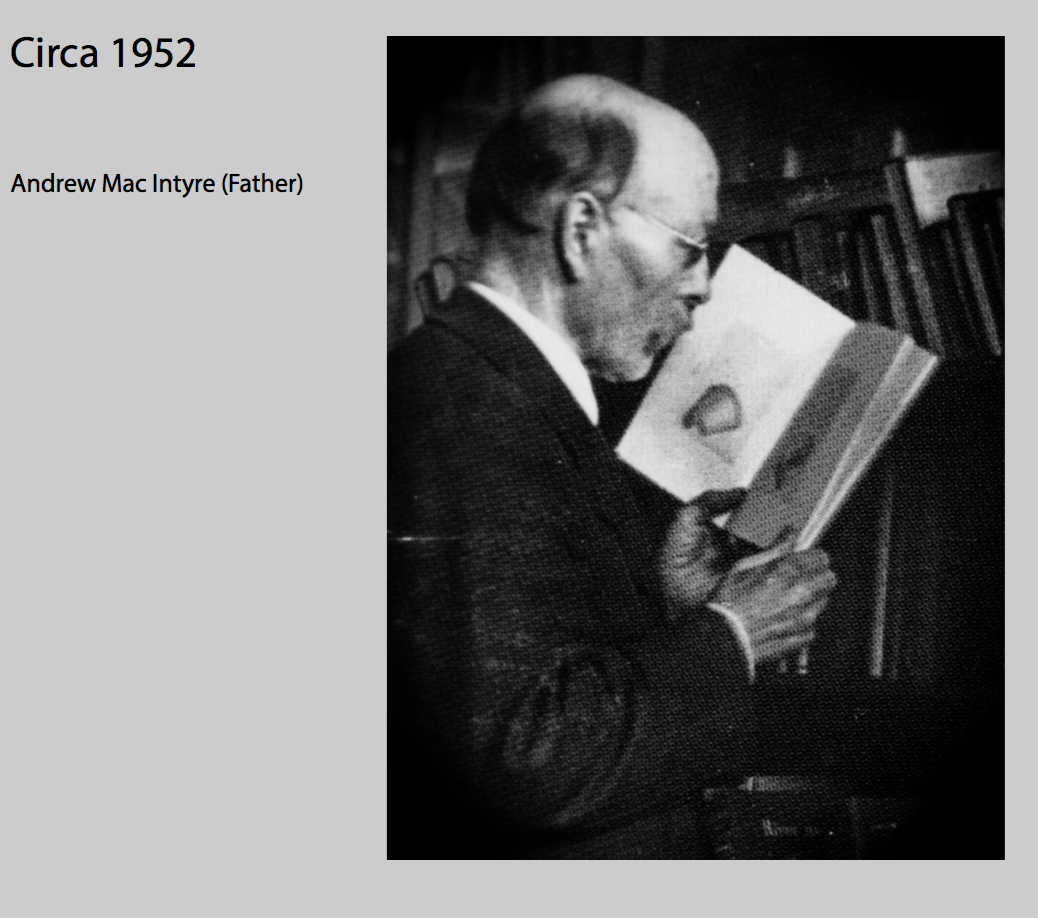
 Andrew MacIntyre, the poet, was born in 1877 at Ballymore. His parents were James MacIntyre and Letitia (nee Collins). The MacIntyres were always locally known as MacAteers and were natives of Knockfaugher.
He was the eldest of a family of six and from a very young age took a great interest in learning. He attended Ballymore National School where his teacher was Miss Mary Parker, to whom he was later in life to write: “She had the art of inspiring those under her charge with a love of learning and a desire for more knowledge-I feel I owe a deep debt to her which I can never repay.”
After he left school he was appointed postman in the district, with the rank of rural auxiliary at a wage of 5/-per week. He did not know to whom, or to what, he was auxiliary as there was no one except himself. His walk each day was Ballymore, Cloonmass, Lower Faugher, Marblehill, Knockduff, Parkmore, Dundridian, Breaghy, Portnablagh, Rockhill, Middle and Upper Faugher and later Knocknafaugher. When the last town land was added he received an increase of 6d a week. He continued for eleven years and nine months and gave it up in the middle of December 1909 when he had reached the sum of 8/6d per week.
During those years he had a good deal of time to himself in the evenings and employed it in reading widely and in studying Irish, French and Shorthand. Mr Hugh A. Law M.P. (Old Irish Parliamentary Party) and T.D. Cumann-na-Gael until 1932, placed his extensive library at his disposal. He had accumulated books of his own especially poetry and drama. He had Dick’s Shilling, Shakespeare, Moore, Byron, Tennyson, Robert Browning Cowper, Sullivan, Cardinal Moran’s “Persecutions of the Irish Catholics under the Penal Laws” and other works.
It was during his years as postman that he wrote a lot of his songs and poetry and he also became friends with George Russell (A.E.), Percy French, G.K. Chesterton, Stephen Gwynn, Frank Cousins, Yeats – in fact all the literati of the time.
While Irish was his favourite language he was able to go on and become an authority on classical Latin, while also being fluent in German, Greek and Italian. Once, before the First World War, he had a conversation with a German travelling salesman in Margaret Diver’s home in Breaghy, much to the surprise of the German, who was probably a spy anyway. The German inquired afterwards from Margaret “what University was MacIntyre attending?” – to which Margaret replied that the only University he had ever been in was Ballymore School.
Andrew had a great love of language and having mastered Irish, turned to Latin and Greek, which he was later to advise everyone to learn because all the other languages then came easy. He studied hard and gained experience of sounds and intonation by speaking to the many visitors to the area.
At the age of 16 he was badly burned on his chest when he fell asleep while reading with the candle sitting on a saucer on his chest.
In September 1914 he was appointed Master of the Dunfanaghy Workhouse and was there until 31st.March 1917, when the institution was closed and the inmates sent to Milford.
In 1918 he became school attendance officer for Clondahorkey after the resignation of Niall McBride at £12 per annum – later increased to £18.
In 1921 the Carnegie Irish Advisory Committee in Dublin offered him the assistantship in the new Carnegie Library – the first County Library in Ireland – at Lifford. He went to Lifford in January 1922 at £2 per week.
In March 1923 he was appointed Co. Librarian at £150 per year. At the end of 1923 the Carnegie Trust Dunfermline, told him that he would have to pass an examination before they could recommend he be appointed Co. Librarian by the County Council to which they were handing over. The examination was held and there were many applicants from all over Ireland – all with University degrees.
Andrew MacIntyre came first – gaining 100% in all subjects except English in which he received 99%
He became the first County Librarian in Ireland to be appointed by an Irish Authority. He was later to set and mark exams for similar positions throughout Ireland.
When he resigned the position of school attendance officer, his brother-in-law, Mr Edward Coll, Breaghy succeeded the position and remained there until 1927/28 when the position was abolished and handed over to the Gardai.
Among the songs for which he is best known is: “The Maid of Marblehill”.
He died in 1959.
Written by Andrew Eunan MacIntyre
 lovemacintyre.com
You must be logged in to post a comment.